Ask any strong chess player how they improved and you will hear the same advice: study master games. Master games show you how to form plans, coordinate pieces and convert advantages - things puzzles and opening drills cannot teach. Here is how to study them properly.
Why studying master games works
Tactics win games, but plans decide which tactics are possible. When you replay a master game you see an expert's chain of decisions from opening to endgame. Over time your brain stores these as patterns, so in your own games good ideas start to feel obvious.
Step 1: Choose well-annotated master games
An unannotated game is a list of moves. An annotated game explains why the moves were played. Look for games annotated in words, not just engine evaluations. Classic collections such as Irving Chernev's Logical Chess: Move by Move explain every move and are ideal for players under 1600. Stronger players can use tournament books, such as David Bronstein's book on the Zurich 1953 tournament.
Choose games that match your openings: if you play 1.e4, study open games; if you play the Queen's Gambit, study classical d4 games.
Step 2: Get an overview first
Play through the game quickly, without stopping, to see its story. Where did the opening end? When did one side get an advantage? Was it decided by an attack, a structural weakness or the endgame? This takes five minutes and gives your deeper study a framework.
Step 3: Play guess-the-move
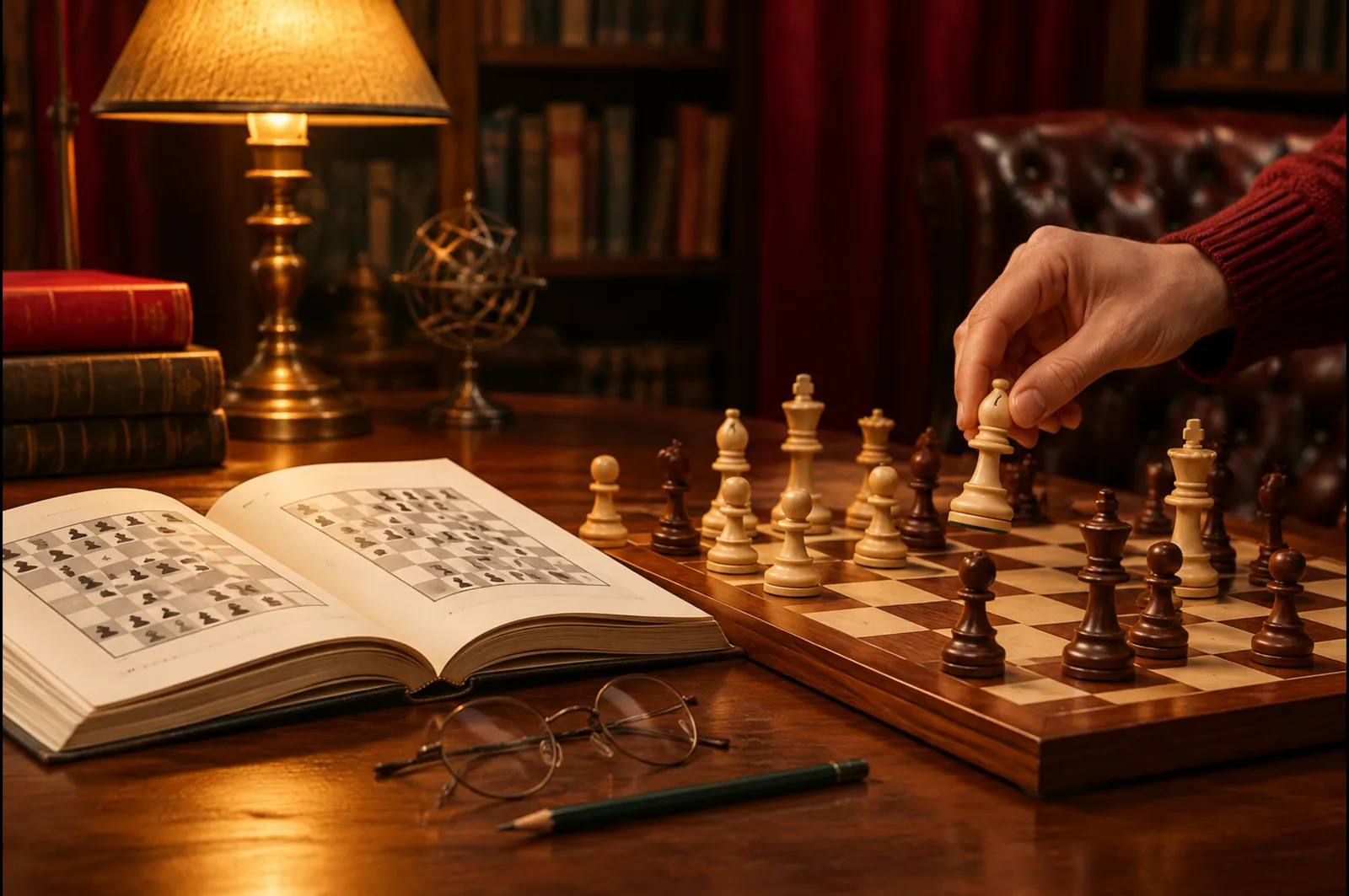
This is the heart of the method. Cover the moves and pick a side - usually the winner. At each move, decide what you would play and write it down with a short reason. Then reveal the master's move.
- If you matched the move, check whether your reason matches the annotation.
- If you did not, set the position up and work out why the master's move is better.
- Score yourself: one point for the right move, extra points for the right idea.
Why it works: guessing forces you to think like a player instead of watching like a spectator. Research on expertise consistently shows that active recall builds stronger memory than passive review.
Step 4: Compare your thinking with the annotations
After each critical moment, read the annotations carefully. Pay special attention to moves you rejected - masters often explain why a natural-looking move fails. Use an engine only after you have formed your own opinion; it is a checking tool, not a teacher.
Step 5: Record the key lessons
Write two or three lessons per game in a notebook or digital file: "Knight on d5 against a bishop with pawns on dark squares", "Rook on the seventh rank wins pawns in the endgame". Revisit the file monthly. This is your personal master games library, organised by idea rather than by player.
Which master games to start with
Start with short games from the 1800s, where tactical ideas are easy to see, then move to classical positional games and finally modern dynamic play. Our list of famous master games follows exactly that order.
A 4-week study plan
| Week | Focus | Suggested games |
|---|---|---|
| 1 | Development and attack | Morphy's Opera Game; Anderssen's Immortal Game |
| 2 | Combination play | The Evergreen Game; Rotlewi vs Rubinstein |
| 3 | Positional understanding | Botvinnik vs Capablanca, AVRO 1938 |
| 4 | Endgames | Capablanca's rook endgames |